







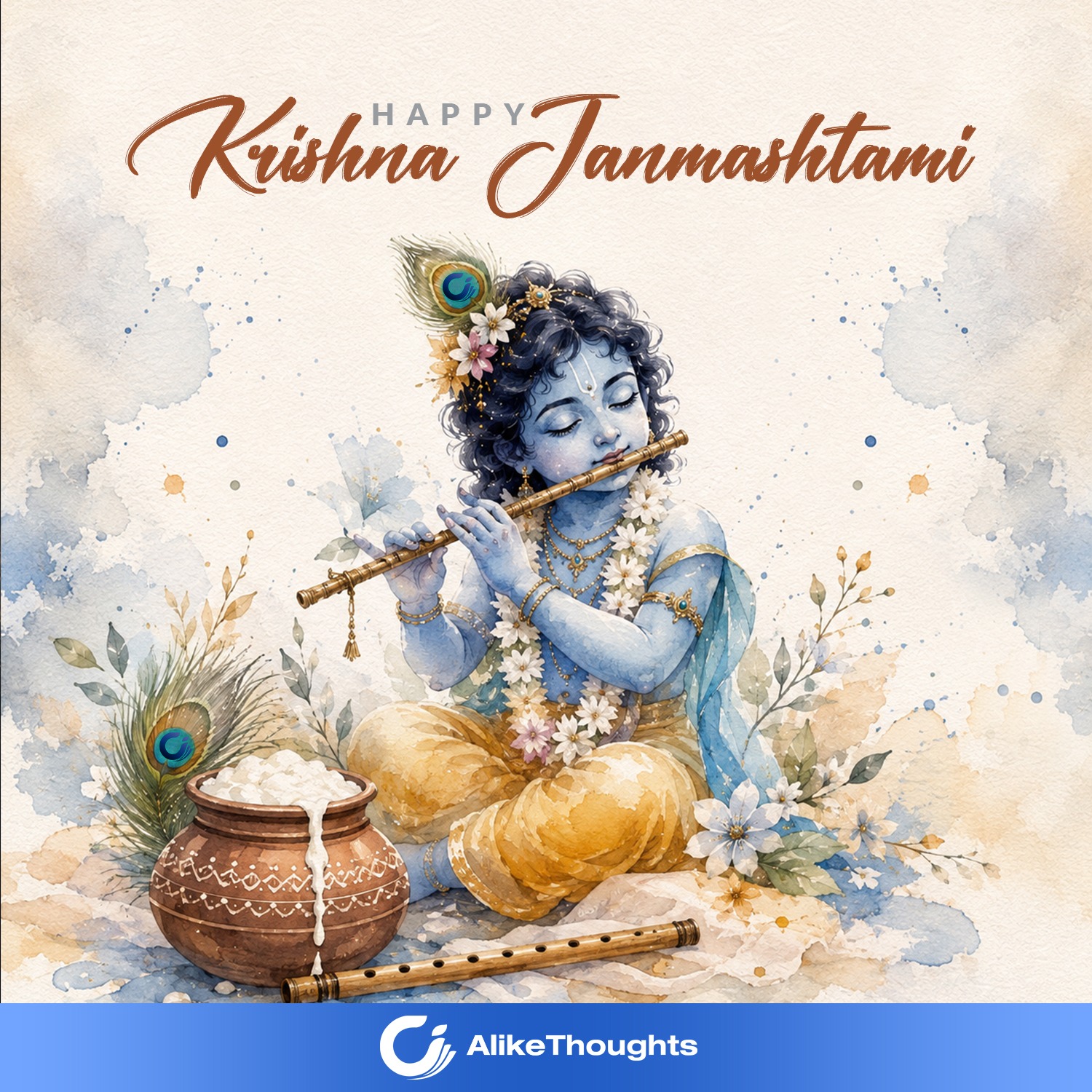
🦚 Janmashtami: What Krishna’s Life Can Teach Us About Navigating a Changing World
Janmashtami marks the birth of Lord Krishna, a figure whose story has been told for thousands of years. But beyond the celebrations, devotional songs, and stories of his childhood, Krishna’s life offers ideas that remain surprisingly relevant in the world we live in today.
Krishna was born in Mathura to Devaki and Vasudeva at a time when fear and injustice had taken hold under the rule of King Kansa. To protect him from Kansa, Krishna was taken to Gokul, where he spent his childhood. As his life unfolded, he became much more than the playful child of Gokul. He grew into a strategist, diplomat, philosopher, and guide—eventually playing a crucial role in the events leading to the Mahabharata.
What makes Krishna’s journey interesting is not simply the historical or mythological significance of these events, but the way he responded to changing circumstances.
The Power of Adaptability
Krishna’s life was marked by constant change. He moved from Gokul to Mathura, later established Dwarka, navigated political conflicts, and dealt with situations where there was rarely a simple answer.
He did not approach every problem in the same way.
Sometimes, he used diplomacy. Sometimes, strategy. Sometimes, patience. And when necessary, he encouraged decisive action.
That is an important lesson for the modern world.
Today, change happens at an extraordinary pace. Artificial intelligence, automation, cloud technology, digital transformation, and emerging technologies are changing how businesses operate and how people work. Skills that are valuable today may evolve tomorrow.
In such an environment, adaptability is no longer simply a desirable quality. It is becoming essential.
The lesson from Krishna is not to resist change, but to understand it and respond intelligently.
When Knowledge Needs Wisdom
One of Krishna’s most significant roles comes during the Kurukshetra war, when Arjuna finds himself overwhelmed by doubt and uncertainty.
Krishna does not fight the battle for him. Instead, he helps Arjuna understand his responsibility, confront his doubts, and make his own decision.
This distinction is particularly relevant today.
We have access to more information than any generation before us. With AI tools, analytics, automation, and instant access to knowledge, finding information is becoming easier.
But having information is not the same as having wisdom.
The real advantage lies in knowing what information matters, asking the right questions, understanding the context, and making responsible decisions.
Technology can provide answers. People still need to decide which questions are worth asking.
The Lesson of Karma in the Age of Technology
The Bhagavad Gita is perhaps Krishna’s most enduring contribution. Among its many teachings is the idea of focusing on one’s actions and responsibilities rather than being consumed by the results.
In today’s professional world, this principle can be viewed through a modern lens.
We work with targets, deadlines, performance metrics, project outcomes, and business goals. While outcomes matter, becoming excessively focused on them can sometimes distract us from the quality of the work itself.
The better question is:
Are we learning? Are we improving? Are we creating value? Are we giving our best to the responsibility in front of us?
This mindset becomes even more relevant as technology changes the nature of work. Instead of trying to compete with every new technological development, professionals can focus on becoming better at learning, adapting, creating, and solving problems.
Leadership Is Not Always About Being in Front
Krishna’s leadership style is also worth reflecting upon.
He was not always the person holding the weapon or standing at the centre of the battlefield. In the Kurukshetra war, he chose to be Arjuna’s charioteer and guide.
Yet his influence was enormous.
This offers a different perspective on leadership. Leadership does not always mean having the highest position, the loudest voice, or being the person who takes all the credit.
Sometimes, leadership means creating clarity when others are uncertain, helping people recognise their strengths, and enabling them to make better decisions.
In modern organizations, particularly technology-driven ones, this kind of leadership is increasingly important. Complex projects require people who can collaborate across teams, share knowledge, mentor others, and bring different perspectives together.
From Krishna’s Era to the Age of AI
The world Krishna lived in and the world we live in could not be more different.
Yet human challenges remain remarkably familiar.
We still face uncertainty. We still make difficult choices. We still experience failure, ambition, conflict, fear, and change.
The difference is that today’s challenges are increasingly accompanied by technological complexity.
AI can write code. Automation can perform repetitive tasks. Data can reveal patterns. Digital platforms can connect people across continents.
But technology still needs human judgment, creativity, ethics, empathy, and purpose.
That may be one of the most relevant lessons we can take from Krishna’s story: tools may change, but the wisdom with which we use those tools matters even more.
A Festival That Invites Reflection
Janmashtami is much more than a celebration of Krishna’s birth. It is also an opportunity to reflect on the ideas his life represents—courage in difficult times, adaptability in changing circumstances, wisdom in decision-making, and responsibility in action.
As we move deeper into an era shaped by AI and rapid technological change, these lessons become increasingly valuable.
We don’t know exactly what the future of technology will look like. But we can choose how we approach it.
We can remain curious instead of fearful.
We can adapt instead of resist.
We can learn instead of assume we already know enough.
And we can use technology not simply to move faster, but to create something meaningful.
This Janmashtami, perhaps the greatest lesson is not about looking back at the past, but carrying its wisdom forward.
May we have the courage to face change, the wisdom to navigate it, and the purpose to use our knowledge for something greater.
Happy Janmashtami! 🦚✨
