







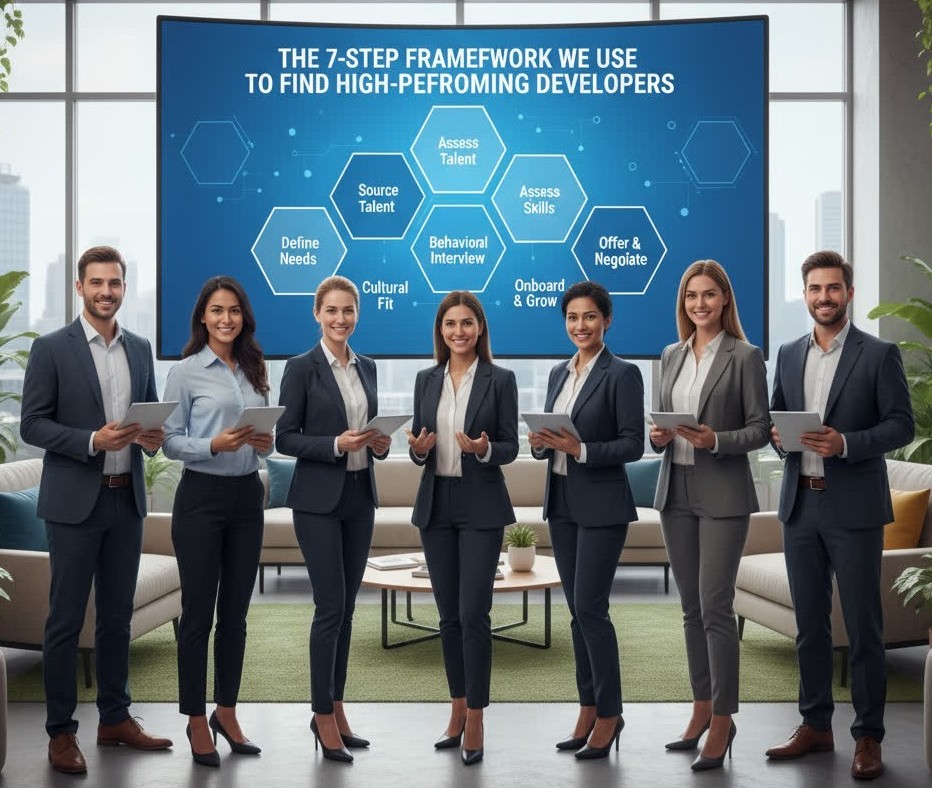
The 7-Step Framework We Use to Find High-Performing Developers
Hiring great developers has become one of the toughest challenges for growing businesses today. The tech market is saturated, competition for talent is fierce, and the best engineers are often already employed — or not even looking. Yet, the success of any product or technology-driven company depends on building a strong engineering team.
At our recruitment agency, we’ve learned that great developers aren’t found by chance — they’re identified through a thoughtful, insight-driven process. Over time, we’ve refined a seven-step framework that consistently helps us attract, evaluate, and onboard top-performing developers for our clients. It’s a mix of data, intuition, and partnership — and it works. Here’s how.
1. Understanding the Business and Tech Landscape
Every successful hire begins with understanding the client’s world. Before we even begin sourcing, we take time to study your product, business goals, and the technical ecosystem you operate in. We want to know what problems the new hire will be solving over the next six to twelve months, what technologies power your product, and how your teams collaborate.
This isn’t a one-size-fits-all approach. Hiring a backend developer for a fintech platform is very different from hiring one for a SaaS startup or a gaming company. The technical challenges, pace, and culture differ. By gaining a full picture of your business and team dynamics, we can target candidates who won’t just fit your tech stack but will align with your purpose and growth trajectory.
2. Defining the “High-Performer” Profile
Once we understand your world, the next step is defining what “high-performing” really means for your organization. Every company has its version of excellence. Some need a fast-learning generalist who thrives in chaos, while others require a deep specialist who brings stability and precision.
Together with you, we create a success profile that goes beyond a job description. We identify the technical capabilities, problem-solving styles, and personal attributes that predict long-term success in your environment. This process helps us look past keywords and titles to focus on what truly matters — attitude, curiosity, learning agility, and collaboration. The clearer the picture we paint at this stage, the better the match we deliver later.
3. Strategic Sourcing
Finding Hidden Talent Once the target profile is defined, we begin the hunt. This is where experience and networks matter. Great developers are not always actively applying for jobs. Many are heads-down in projects or content in their current roles — but open to opportunities that excite them.
Our sourcing strategy blends technology and relationships. We use AI-powered tools for talent mapping and market insights, while also engaging with niche communities, forums, and events where skilled developers spend their time. Our recruiters connect with candidates on LinkedIn, GitHub, and Stack Overflow, and we lean heavily on trusted referrals built over years in the industry. This approach gives us access to both active and passive talent — often the kind you won’t find on job boards.
4. Multi-Layered Screening and Technical Validation
After identifying potential candidates, we move to a rigorous screening and validation process. We believe in quality, not volume. Every candidate undergoes a structured evaluation that goes beyond superficial questions. We assess real-world problem-solving, the ability to write clean and efficient code, and how they think through challenges.
Instead of relying solely on automated tests, we conduct thoughtful conversations that reveal a candidate’s depth of understanding. We explore how they approach complex scenarios, manage ambiguity, and collaborate with teammates. Communication is a big part of our evaluation — because even the most skilled developer won’t thrive in a team if they can’t communicate ideas effectively.
Our goal here isn’t just to find someone who can code, but someone who can contribute meaningfully to a team’s success.
5. Culture Fit and Value Alignment
Technical skills may get someone hired, but culture and values determine whether they stay and grow. We take cultural compatibility seriously — and we interpret it as “culture add” rather than “culture fit.” We look for individuals who align with your organization’s values but also bring new perspectives and diversity of thought.
During this stage, we assess how candidates handle feedback, how they collaborate, and how they adapt to change. We often involve our clients’ team members in this phase so they can sense chemistry and shared values early. This step is vital because a misaligned hire can disrupt productivity and morale, whereas a culturally aligned one can amplify both.
6. Transparent Shortlisting and Collaborative Interviews
Once the evaluations are complete, we present a carefully curated shortlist of candidates who have cleared every stage of our internal process. Rather than overwhelming clients with dozens of resumes, we focus on delivering a few strong contenders — each accompanied by detailed insights on their strengths, motivations, and suitability.
We don’t stop at shortlisting. We also collaborate with your hiring team to design structured interviews, align on scoring criteria, and ensure a consistent evaluation experience. This not only speeds up decision-making but also reduces unconscious bias and ensures every interviewer focuses on what truly matters. The result is a smoother, faster, and more transparent hiring process for everyone involved.
7. Offer Management and Seamless Onboarding
The final stage is about sealing the deal — and ensuring a smooth transition. After a candidate is selected, our consultants stay actively involved in offer negotiations, counteroffer management, and pre-joining engagement. We make sure expectations are aligned on both sides — from compensation and role clarity to growth opportunities.
We continue to stay in touch post-offer and during onboarding to help both the client and the candidate navigate the first few weeks. This personal involvement reduces last-minute dropouts and keeps our offer-to-join ratio consistently above 90%. For us, a placement isn’t complete until the candidate is thriving in their new role.
What Makes This Framework Effective
What sets our approach apart is its balance between structure and flexibility. The seven steps aren’t rigid checkboxes — they’re guiding principles that we adapt to each client’s unique context. By combining deep discovery, precise targeting, and human insight, we minimize hiring risks and maximize results.
This framework helps our clients build teams that don’t just deliver code, but drive innovation, improve culture, and strengthen long-term business outcomes. It also saves them time and energy by replacing guesswork with a proven, transparent process.
Final Thoughts
In a market where hiring can often feel rushed, random, or purely transactional, our mission is to bring back thoughtfulness and precision to recruitment. We believe every hire should be a strategic decision — one that aligns with your company’s purpose and propels it forward.
Our 7-step framework is designed to do just that: combine data, intuition, and experience to connect you with developers who perform, stay, and grow.
